In 2016, California issued 1,336 permits for accessory dwelling units. In 2024 it issued 30,354, and ADUs made up more than a quarter of all new homes permitted in the state. That jump didn't happen by accident: a decade of state laws stripped away the local rules that used to make backyard cottages nearly impossible to build. If you own a single-family home in the Bay Area, those laws have quietly handed you a valuable option. Here's what an ADU is, how the rules work, what one costs, and when building one makes sense.
California's housing crisis, in brief
California simply hasn't built enough homes for the people who live here. Estimates of the statewide shortage generally exceed 1 million units and run as high as 3.5 million. The result shows up in prices: the typical California home, counting single-family houses and condos together, was worth about $776,000 in the first seven months of 2026, more than double the U.S. figure of about $372,000, and rents run more than 30% higher than the national average (PPIC, Sept 2026). Here on the Peninsula and in Silicon Valley, it's roughly double the state figure again: the median home price across Santa Clara and San Mateo counties, including condos and townhouses, was $1,610,000 in September 2026 (MLS data).
The state's official goal is about 2.5 million new homes by 2030, or roughly 312,500 a year. Actual production is nowhere close: California permitted only about 114,000 homes of every kind in 2024 (estimated from ADU figures published by the California Department of Housing and Community Development, or HCD, the state agency that oversees ADU law), and just five of its 539 cities and counties are on pace to meet their targets. Those targets are each community's share of the statewide goal, assigned by the state every eight years and split by income level, from affordable housing to market-rate homes (CalMatters, HCD).
That gap is a big reason the state keeps pushing ADUs. Homeowners build them on land they already own, with no new roads or large developments, so they keep going up even when bigger projects stall. ADUs already account for more than a quarter of new homes permitted statewide, and the Legislature has amended ADU law almost every year to make them easier still.
What counts as an ADU?
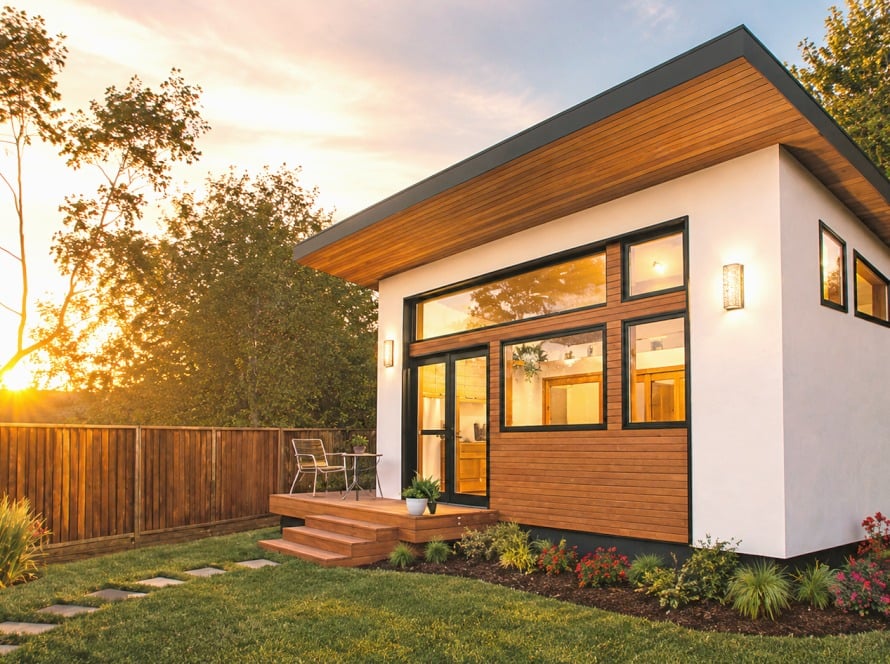
An ADU is a second, fully independent home on the same lot as a house or apartment building, with its own provisions for living, sleeping, cooking and bathing (HCD ADU Handbook, March 2026). It can be attached to the main house, detached in the backyard, or carved out of existing space such as a garage. Manufactured homes and efficiency units can qualify too.
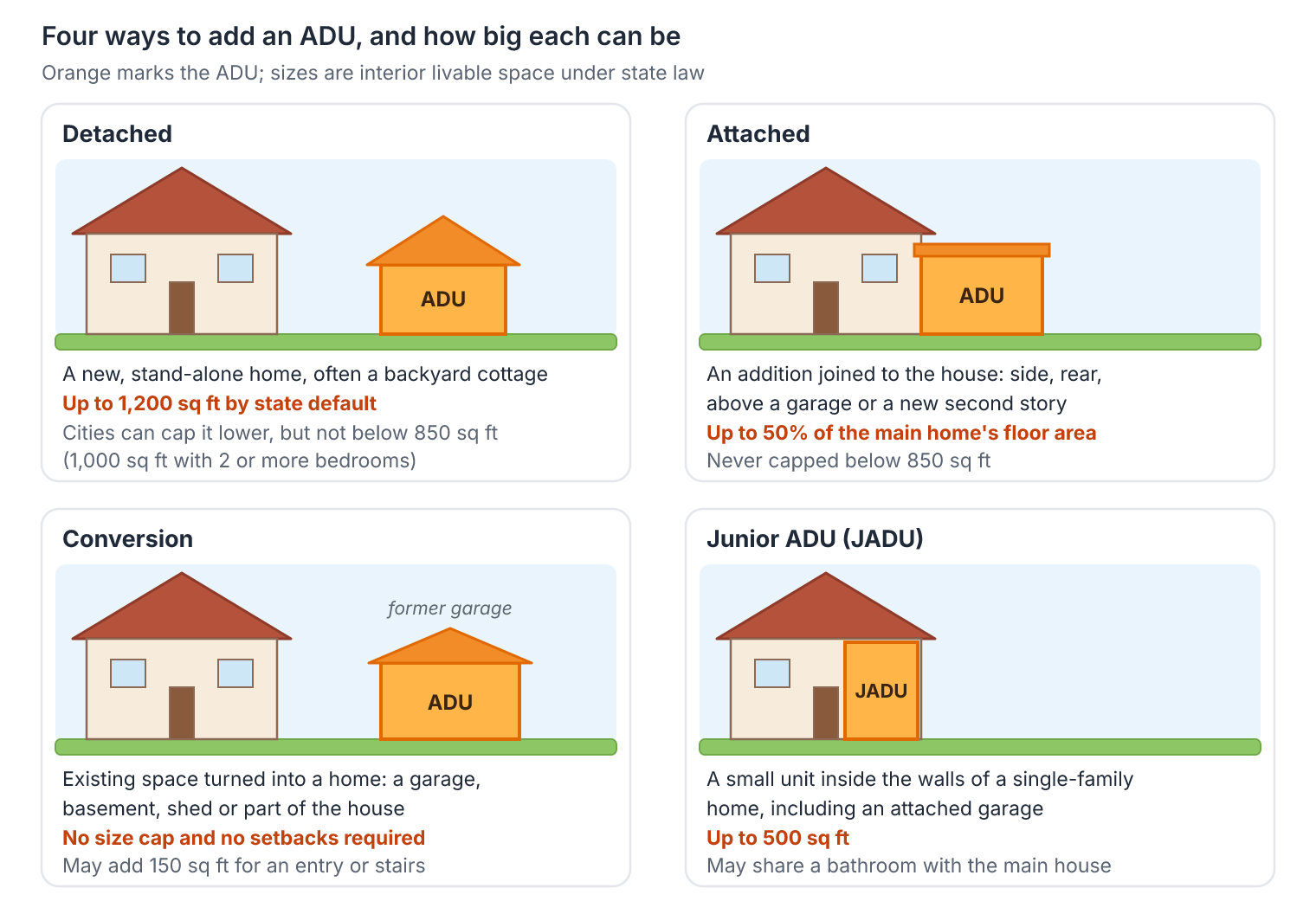
ADU types and size limits · HCD ADU Handbook, March 2026
On a typical single-family lot, you can build up to three units: a converted space such as a garage, a junior ADU inside the house, and a new backyard ADU of up to 800 sq ft.
Apartment properties get their own, bigger allowance. For ADU purposes, any lot with two or more attached homes counts, so a duplex or fourplex qualifies, not just large buildings. Owners can use either or both of two options:
- Convert unused space inside the building. Storage rooms, boiler rooms, attics, basements, garages or a leasing office can become ADUs: at least one, and up to 25% of the building's existing unit count.
- Add detached ADUs on the lot. Up to eight new stand-alone units, but never more than the number of homes already there, built 4 ft from the side and rear lines. A lot where a new apartment building is being proposed gets up to two.
For example, a fourplex could add one conversion unit and up to four detached ADUs, going from four homes to nine. A 12-unit building could add three conversion units and eight detached ADUs (HCD).
How the laws changed
ADUs have technically been legal in California since 1982, but for decades cities buried them under rules on parking, lot size, owner occupancy and fees, and almost none got built. Since 2016 the Legislature has rewritten ADU law nearly every year. Two packages did most of the work:
The 2016 breakthrough (SB 1069 and AB 2299, effective 2017). For the first time, the state set rules every city had to follow: approve ADUs administratively, with no public hearing, and stop demanding extra parking and steep utility fees. Permits nearly quadrupled in a year, from 1,336 in 2016 to about 5,000 in 2017.
The 2019 package (AB 68, AB 881 and SB 13, effective 2020). This cleared most of what was left: no minimum lot size, 4-ft side and rear setbacks, no replacement parking when you convert a garage, an ADU and a junior ADU allowed on the same lot, a 60-day review clock, and fee relief for units under 750 sq ft. After a pandemic pause in 2020, permits roughly doubled to about 25,000 by 2022.
Since then, the changes have mostly closed loopholes and added enforcement:
- 2022: cities may apply only objective standards and must approve or deny within 60 days; higher height minimums.
- 2023: owner-occupancy requirements banned permanently; cities may let ADUs be sold as condos (AB 1033); HCD gains power to enforce; cities must offer pre-approved plans.
- 2024: up to eight detached ADUs on apartment lots; a path to legalize unpermitted units built before 2020.
- 2025: 15-day completeness checks, appeal rights and clearer fee exemptions; local ADU rules void if not filed with the state.
Sources: HCD ADU Handbook, California YIMBY, Best Best & Krieger.
The impact: an ADU building boom
The laws worked. Statewide ADU permits climbed from 1,336 in 2016 to 30,354 in 2024, when ADUs made up more than 26.6% of all homes permitted in California (HCD).
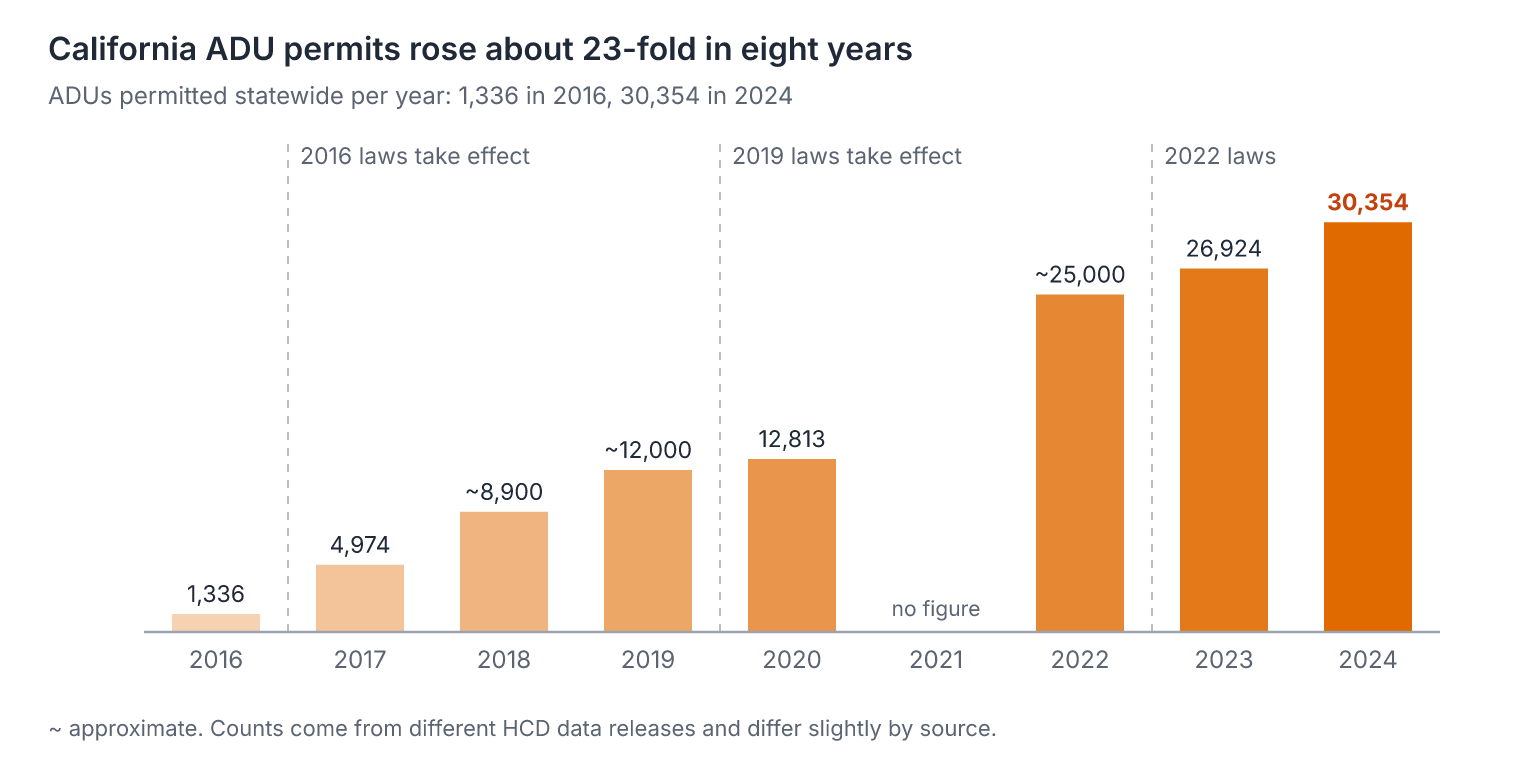
HCD annual progress report data via HCD ADU Handbook (2016, 2023, 2024), Building an ADU (2017-2018), Senate Housing Committee (2020, 2022), Brandon Donnelly (2019)
Each jump follows a round of legislation: the 2016 laws unlocked the first wave, and the 2019 package removed lot-size, parking and setback barriers. The only flat year was 2020, during the pandemic. Between 2016 and 2022 alone, California permitted 83,865 ADUs (California YIMBY). The Peninsula leans in even harder: ADUs were 48% of all new housing permitted in San Mateo County in 2024 (San Mateo Daily Journal).
Setbacks: 4 feet versus 20
A city can require an ADU to sit no more than 4 feet from the side and rear property lines (HCD). That is a fraction of what Bay Area zoning demands of the main house, and it is why a backyard that looks too small for a second home often isn't.
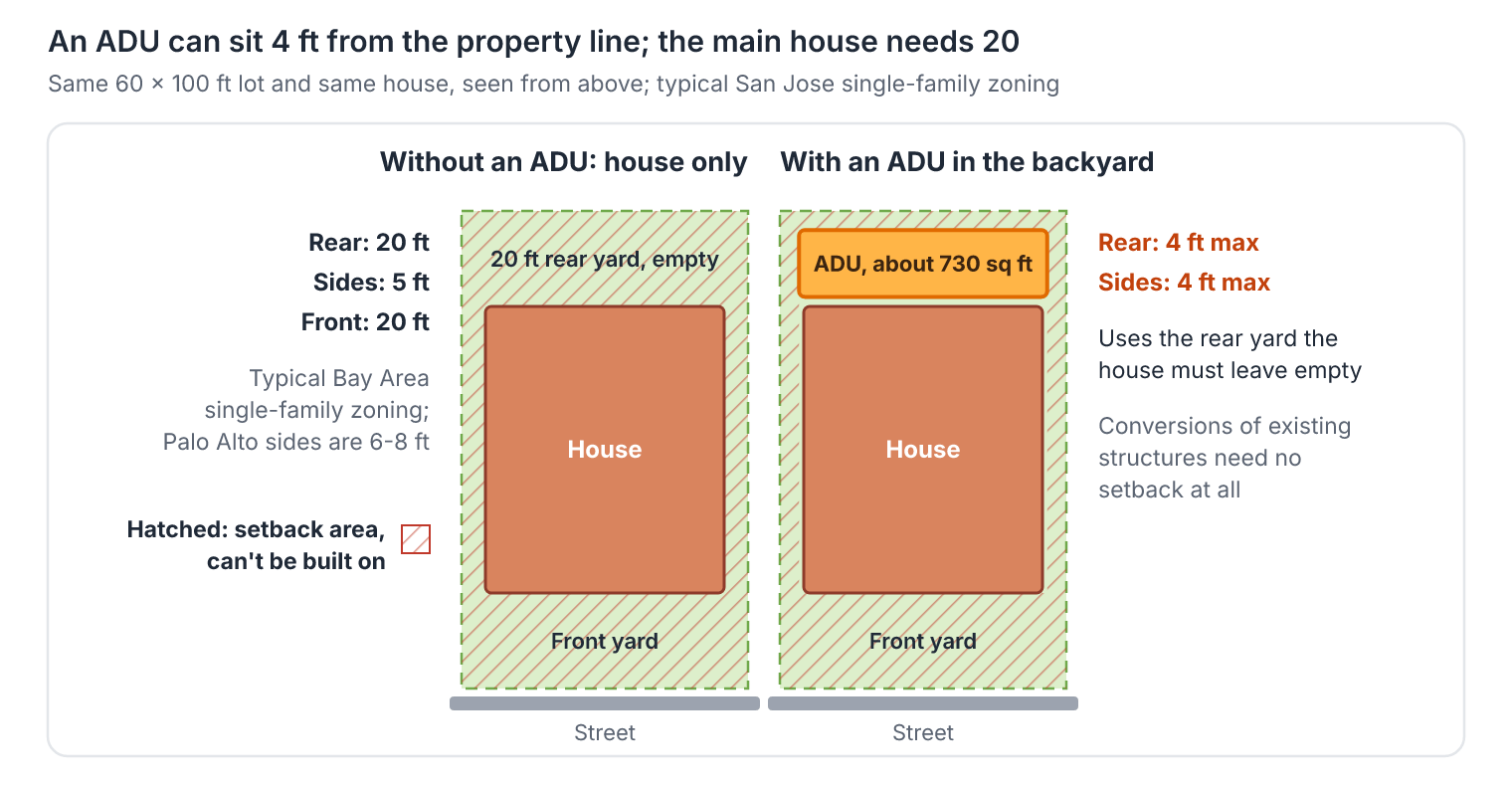
Setbacks compared · HCD ADU Handbook; San Jose and Palo Alto zoning codes
City figures: San Jose R-1-8, Palo Alto R-1. Check your own parcel's zoning; standards vary by district and lot.
Height rules also work in your favor: cities must allow at least 16 ft for a detached ADU, 18 ft near major transit (plus 2 ft to match roof pitch), and up to 25 ft for an attached ADU, which means two-story ADUs can be possible even where the neighborhood is zoned single-story (HCD).
Why state law beats your city's rules
State ADU law sets a floor that every city and county must meet, charter cities included. Cities can be more generous, but not stricter (HCD).
- Only objective rules. Cities can apply measurable standards like heights and setbacks, but not subjective ones such as "neighborhood compatibility" or "design harmony."
- Ministerial approval. No public hearing, no neighbor sign-off, and no discretionary review. HOAs can't block an ADU or weigh in on the city's approval, and CC&Rs that effectively prohibit ADUs are void.
- Real enforcement. Since 2024, HCD can enforce all ADU laws, and violations can lead to loss of housing element certification or referral to the Attorney General.
In practice, this means the city's rules on paper may be out of date or stricter than the law allows. Where they conflict, state law wins. HCD has been sending compliance letters across the state, including a May 2026 letter to Mountain View noting that its ordinance on file dated from 2023 (HCD letter).
How easy is it to get a permit?
Easier than for almost any other kind of construction, because the state now puts cities on a clock (HCD).
- Completeness check in 15 business days. The city must say whether your application is complete, and if not, list exactly what's missing. Miss the deadline and the application is deemed complete.
- Approve or deny within 60 days of a complete application. A denial must come with a full set of written comments from every reviewing agency explaining how to fix it.
- Appeal rights. Cities must offer a written appeal of incompleteness findings or denials, with a final decision within 60 business days.
- Pre-approved plans. Since 2025, every city must run a program to pre-approve ADU plans and post them online, which can cut design time and plan-check risk.
- No environmental review. Ministerial ADU approvals are exempt from CEQA.
The clock governs the permit, not your whole project: design, utility work and construction still take months. Applicants can also pause the 60-day clock themselves if they need time to revise plans. If a city stalls, homeowners can ask HCD for technical assistance through its online ADU portal.
A local example: Los Altos
Most of Los Altos's ADU rules, such as the 4-ft setbacks, 16-ft height minimum, size floors and 30-day rental minimum, simply mirror state law. But the city goes further than the state requires in a few ways:
- No city permit fees. Los Altos charges $0 for the ADU building permit, plan check, and electrical, mechanical and plumbing permits. Utility, sewer, school and other outside fees still apply (City fee schedule, FY 2026-27).
- Free city-designed plans. The city offers permit-ready plans for detached ADUs at no cost, in three sizes (525, 854 and 1,190 sq ft) and three styles (Mediterranean, Traditional and Contemporary). They include structural, mechanical, electrical and plumbing drawings, and can't be modified (City of Los Altos).
- Pre-approved designer plans. A separate program lets private designers get detached ADU plans pre-reviewed by the city. As of this writing, no plans had been listed yet.
One thing Los Altos has not done is opt into AB 1033, so ADUs there can't yet be sold separately from the main house (Bay Legal).
What does an ADU cost in the Bay Area?
Plan on roughly $300 to $500 per square foot for a new detached ADU in the Bay Area, or about $250,000 to $450,000 for a typical fully permitted unit, according to a Bay Area contractor's 2026 estimates (Rhino Builders).
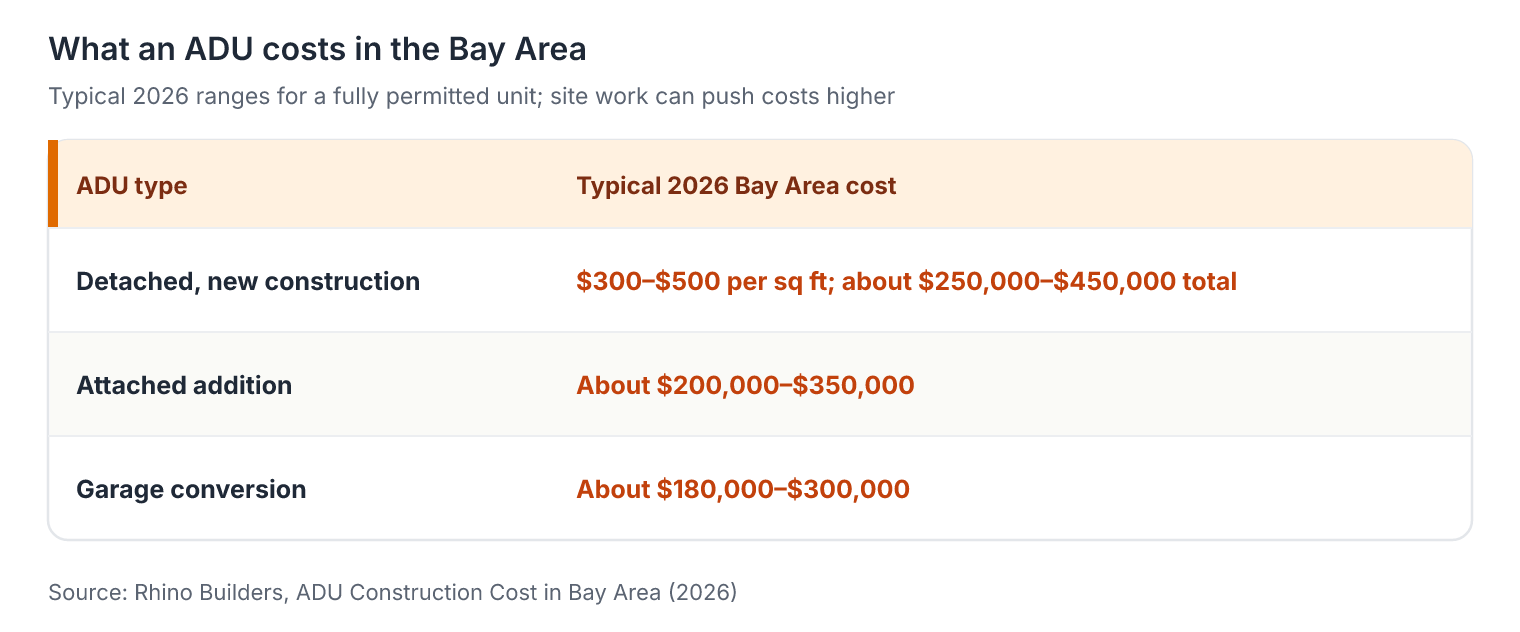
The per-square-foot number misleads on small units, because a kitchen and bathroom cost about the same whether the ADU is 400 or 900 sq ft. The surprises are usually below ground: long sewer or utility trenches, an electrical panel upgrade, seismic engineering and Title 24 energy requirements. The same contractor cites a 750 sq ft project budgeted at $220,000 that finished near $340,000 for exactly those reasons.
State law trims some costs. ADUs of 750 sq ft or less of interior livable space pay no impact fees, and units of 500 sq ft or less pay no school fees. Larger units pay impact fees only in proportion to the main home's size. Conversions inside existing space can't be charged new utility connection fees in most cases (HCD). Expect 9 to 16 months from first design to move-in: 3 to 6 months for design and permits, 6 to 10 months to build.
The prefab ADU phenomenon
Prefab ADUs are built in a factory while your permit is in review, then trucked in and craned onto a foundation, often in a single day. Several of the best-known makers are Bay Area companies, and most sell turnkey packages with fixed pricing and state-approved plans. They aren't always cheaper than site-built, but they make budgets and schedules more predictable.
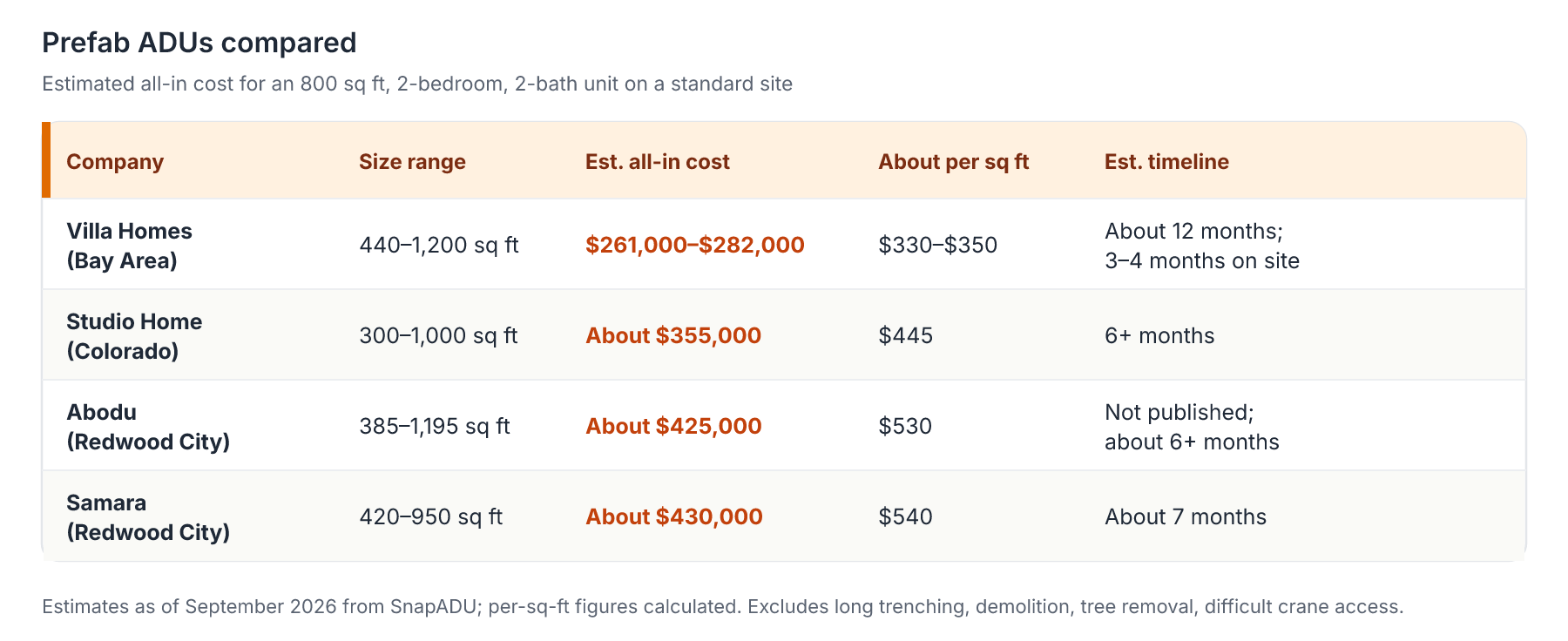
Prefab works best on flat lots with room for a crane and a standard floor plan. Sloped lots, tight access or a custom design usually point to a site-built ADU.
When does an ADU make the most sense?
An ADU pays off best when you have a clear use for it and a lot that doesn't fight you. Strong cases:
- Housing family. Aging parents who want to stay close, or adult children who can't afford Bay Area rents. JADUs and garage conversions are the low-cost entry point.
- Aging in place. Build a single-level ADU, move into it, and rent the main house or hand it to family.
- Rental income. Owner-occupancy is no longer required for ADUs, so investors and owners who move away can rent both units. Rentals must be longer than 30 days for state-guaranteed ADUs and all JADUs. For a sense of scale: over the past 12 months, two-bedroom, one-bath rentals within five miles of Los Altos had a median rent of $3,195 a month, and around Palo Alto $3,350, or roughly $38,000 to $40,000 a year before expenses (Rentometer, October 2026). Those figures cover all 2-bed, 1-bath rentals, not just ADUs, so treat them as a ballpark.
- Existing structures. A garage or basement conversion skips setbacks and costs far less than new construction.
- Flat, accessible lots near transit. No parking can be required within a half-mile of transit, height limits rise to 18 ft, and prefab cranes need clear access.
- Adding value before a sale. In high-cost neighborhoods such as Palo Alto and Los Altos, where every square foot of living space commands a premium, a permitted ADU can add substantial value. It also widens the buyer pool, and lenders including Fannie Mae, Freddie Mac and FHA now count ADU rental income toward qualifying. Make sure the unit is permitted: an unpermitted one won't count in an appraisal (HCD).
It makes less sense on steep or hard-to-reach lots where site work dominates the budget, or if you'd need to sell soon. An unpermitted unit is also worth addressing: units built before 2020 can now be legalized without being denied over most code or zoning issues, unless there is a health or safety risk.
What the future holds
The next chapter is ADUs as homes people can buy, not just rent. AB 1033 lets cities allow an ADU to be split off and sold as a condo. San Jose opted in first, in 2024, and in June 2026 a 749 sq ft, two-bedroom ADU near downtown San Jose sold for $530,000, the first ADU condo sale in California (City of San José, Maxable).
Adoption is still thin. As of July 2026, about nine cities had opted in, including San Jose, San Francisco (for certain newer detached ADUs), Oakland and Berkeley; Los Angeles had not (Bay Legal). Condo mapping, an HOA structure and lender requirements make each sale a real project.
Expect more trends to continue:
- More fee relief. SB 1117, signed by Gov. Newsom in early October 2026 and taking effect January 1, 2027, replaces per-square-foot impact fees on ADUs over 750 sq ft with a marginal fee charged only on the space above 750 sq ft, for the first two ADUs on a property (Planetizen).
- Tougher enforcement. HCD is actively voiding out-of-date local ordinances, so state rules increasingly govern by default.
- Bigger multifamily role. Up to eight detached ADUs on existing apartment lots opens a path for small landlords to add units.
- Steady volume. With ADUs already more than a quarter of the state's new permits, they are now a mainstream housing type rather than a niche.
The bottom line
California has spent a decade making ADUs one of the easiest things to build on a residential lot: 4-ft setbacks, a guaranteed 800 sq ft unit, a 60-day permit clock, no owner-occupancy rule and no impact fees on smaller units. Costs are still real, so the best projects start with a clear purpose and a lot that suits it.
If you're weighing an ADU, whether to house family, earn rental income or add value before a sale, I'd be happy to take a look at your property with you: what kind of ADU your lot could fit, what similar homes with ADUs are selling for, and what it could rent for. I can also connect you with local architects and builders I trust. Buying instead? I can help you find homes with strong ADU potential before you make an offer.
Reach out at 1-408-896-2014 or [email protected] to set up a no-obligation conversation.
Sources
- HCD Accessory Dwelling Unit Handbook, March 2026
- Best Best & Krieger: Governor Newsom Signs Four New ADU Bills (Nov 2025)
- PPIC: Housing in California (Sept 2026)
- CalMatters: RHNA progress (Aug 2026)
- California YIMBY: California ADU Reform, A Retrospective (2024)
- Rhino Builders: ADU Construction Cost in Bay Area (2026)
- SnapADU: Prefab ADUs Compared (Sept 2026)
- Bay Legal: Selling an ADU Separately (AB 1033)
- Maxable: AB 1033 Explained
- City of San José: First ADU Condo Sale (June 2026)
- Planetizen: New CA housing laws (Oct 2026)
- Building an ADU: California ADU permit charts
- Senate Housing Committee analysis (2022 permit figure)
- Senate Housing Committee analysis of AB 2221 (2020 permit figure)
- Brandon Donnelly: ADU supply in California (2019 figure)