INTRODUCTION
Why the San Francisco Peninsula
Stretching from the southern edge of San Francisco down through Silicon Valley, the Peninsula is one of the most sought-after regions in the country — and one of the most varied. Within a 30-mile stretch you'll find dense, walkable downtowns, quiet tree-lined suburbs, coastal bluffs, and the corporate campuses of some of the world's most influential companies, including Apple, Google, Meta, and Nvidia. It's also home to one of the world's most active venture capital ecosystems, drawing entrepreneurs and founders building the next generation of companies.
The lifestyle draw is just as strong as the professional one. A mild, sunny climate makes for a genuinely outdoor-oriented way of life — hiking, cycling, and time on the water are part of everyday routine — and the Santa Cruz Mountains and Sierra ski resorts are both within easy reach for a weekend trip. The region's diversity shows up everywhere, from the range of ethnic and cultural backgrounds that call it home to a dining scene with some of the top-rated restaurants in the Bay Area.
Education is a major part of the story too, anchored by Stanford University along with some of the top-rated public and private schools in the state. Add in local professional sports teams and easy access to world-class culture, and it's no surprise the Peninsula has produced some of the most resilient real estate values in the country. Each city here has its own character, price point, and rhythm — part of what this guide is designed to help you navigate.
A note from Shabber: I've called the Peninsula home for over 35 years, including a career working for major technology companies and startups across the region. Over that time, I've experienced firsthand what makes this area special — from its restaurants and outdoor activities to the rhythms of each individual city. That local knowledge is what allows me to match buyers not just to a price point, but to the place that truly fits their background and financial wherewithal. |
The Peninsula, By the Numbers
● 70+ mi — coastline & open space
● Global HQs — Apple, Google, Meta, Nvidia & more
● Pro Sports — 49ers, Warriors, Sharks & Giants
● Stanford — & top-rated schools
GETTING AROUND
Where Everything Sits on the Peninsula
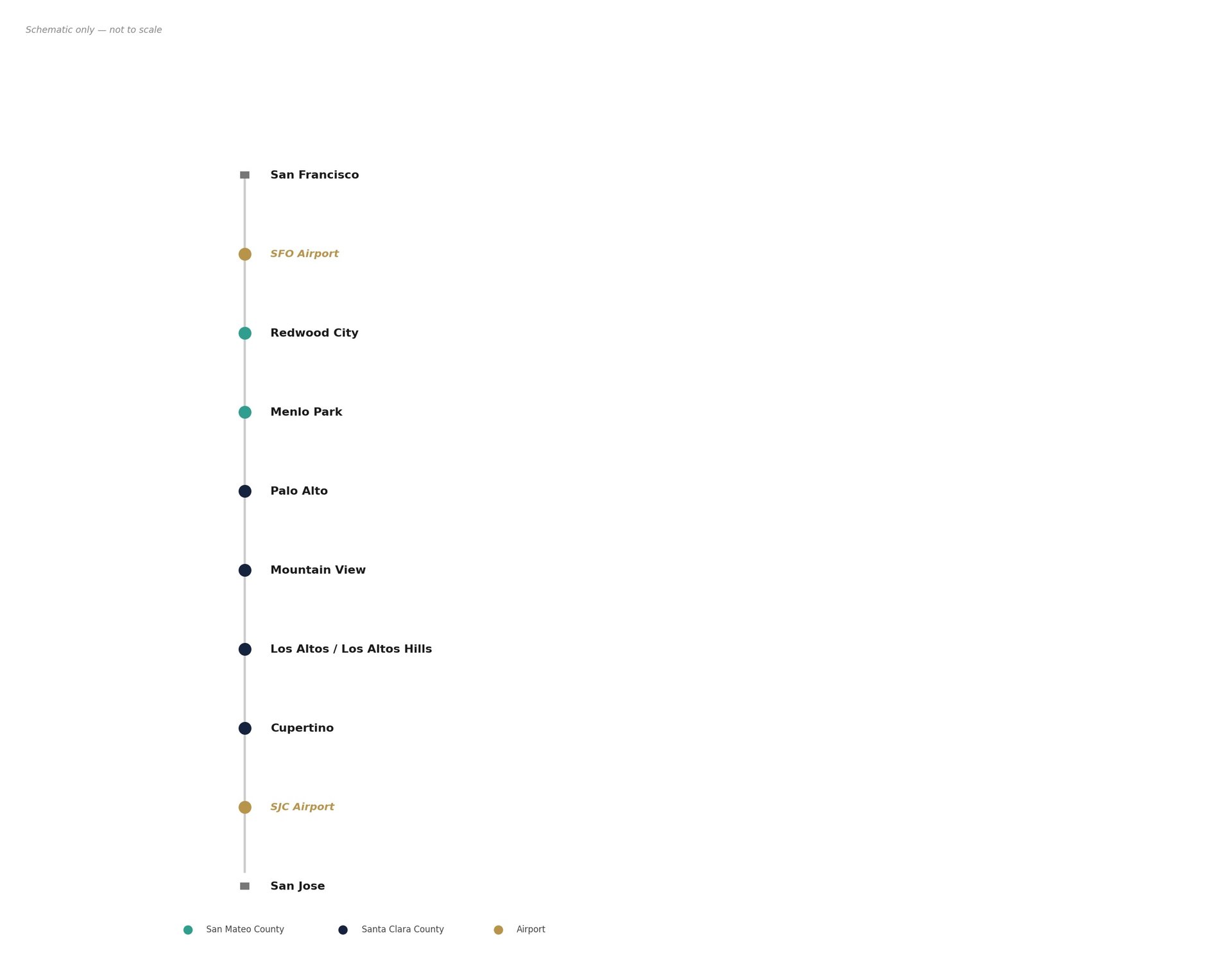
The map below shows roughly how the seven cities line up along the Peninsula corridor, north to south, along with the two nearest airports. The table gives approximate drive times so you can gauge commute and travel convenience for any city you're considering.
Approximate Drive Times
City | From SF | From SFO | From SJC |
Redwood City | 27 mi / 35 min | 14 mi / 18 min | 21 mi / 26 min |
Menlo Park | 31 mi / 40 min | 17 mi / 22 min | 18 mi / 24 min |
Palo Alto | 34 mi / 40 min | 20 mi / 24 min | 15 mi / 20 min |
Mountain View | 38 mi / 47 min | 24 mi / 29 min | 11 mi / 18 min |
Los Altos | 40 mi / 48 min | 26 mi / 31 min | 12 mi / 19 min |
Los Altos Hills | 42 mi / 50 min | 28 mi / 33 min | 13 mi / 20 min |
Cupertino | 44 mi / 52 min | 31 mi / 36 min | 9 mi / 16 min |
Figures are approximate drive times in typical non-peak traffic, based on public mapping data — actual times vary significantly with traffic. Verify current conditions before planning a commute.
AT A GLANCE
Peninsula City Comparison
Market Snapshot
Based on most recent monthly market data — figures shift regularly, contact me for current numbers.
City | County | Character | Homes Sold | Median Price | $/Sq Ft | Days to Sell | Sale/List |
Redwood City | San Mateo | Up-and-coming | 498 | $2,250,000 | $1,259 | 24 | 105.0% |
Menlo Park | San Mateo | Established affluent | 298 | $3,350,000 | $1,711 | 19 | 105.3% |
Palo Alto | Santa Clara | Prestige academic | 399 | $3,930,000 | $2,140 | 24 | 106.2% |
Los Altos Hills | Santa Clara | Rural estate | 106 | $5,487,500 | $1,594 | 34 | 99.0% |
Los Altos | Santa Clara | Quiet upscale | 280 | $4,823,125 | $2,046 | 17 | 107.0% |
Mountain View | Santa Clara | Tech urban | 228 | $2,845,000 | $1,711 | 15 | 107.1% |
Cupertino | Santa Clara | Corporate suburban | 200 | $3,375,000 | $1,692 | 17 | 106.9% |
School Ratings
City | Elementary | Middle | High |
Redwood City | B | B+ | A+ |
Menlo Park | A | A | A+ |
Palo Alto | A+ | A+ | A+ |
Los Altos Hills* | A+ | A+ | A+ |
Los Altos | A+ | A+ | A+ |
Mountain View | B+ | B+ to A- | A+ |
Cupertino | A- | A- | A+ |
Source: Niche.com. * Los Altos Hills is served by the neighboring Los Altos School District.
School district boundaries do not always map exactly to city limits — the ratings above reflect the primary district(s) serving each city, with some extrapolation where a city is split across districts. If a specific school matters to your decision, please verify directly with the district or Niche.com.
GO DEEPER
Full City Guides on My Website
The snapshots on the next few pages are just a starting point. For a deeper look at any city — schools, neighborhoods, local amenities, and more — visit the full city guide on my website.
Redwood City: Guide coming soon — ask me directly in the meantime
Menlo Park: https://shabberjaffer.com/neighborhoods/menlo-park
Palo Alto: https://shabberjaffer.com/neighborhoods/palo-alto
Los Altos: https://shabberjaffer.com/neighborhoods/los-altos
Los Altos Hills: https://shabberjaffer.com/neighborhoods/los-altos-hills
Mountain View: https://shabberjaffer.com/neighborhoods/mountain-view
Cupertino: https://shabberjaffer.com/neighborhoods/cupertino
Don't see your city of interest listed, or want a personal walkthrough instead of reading? Reach out any time — I'm happy to talk through any Peninsula neighborhood directly.
CITY SNAPSHOTS
Peninsula Cities, Up Close
San Mateo County
Redwood City — The value entry point
Redwood City offers the best price-to-access ratio on the Peninsula, with a revitalized downtown along Broadway anchored by the historic Fox Theatre and a fast-growing restaurant scene. The face of the city is undergoing remarkable change right now — remodels are widespread, and it's common to find upgraded homes sitting right next to untouched original houses on the same block. It's the right fit for buyers prioritizing upside and affordability over top-tier school rankings — the tradeoff shows up directly in the numbers, with elementary schools rated a solid “B” rather than the A/A+ range common elsewhere on this list.
Menlo Park — Established, VC-adjacent affluence
Home to Sand Hill Road's venture capital firms and Meta's headquarters, Menlo Park has a quieter, old-money feel than its tech reputation might suggest. It's Stanford-adjacent without Palo Alto's price tag — a fit for buyers who want established affluence and top schools, but don't need the Palo Alto name attached to the address.
Santa Clara County
Palo Alto — You're buying the district
Palo Alto carries the highest price per square foot on this list, and that premium is almost entirely about what comes with it: Stanford University next door and the Palo Alto Unified School District, one of the top-ranked in the country. Lot sizes here also tend to run smaller than in neighboring Los Altos, so buyers are paying primarily for the school district and location, not extra land. This is the city for buyers who see the district itself as the primary investment.
Los Altos Hills — Space, privacy, and views
The outlier on this list — one-acre minimum lot sizes, most homes on septic systems rather than city sewer, and a rural, equestrian-friendly character that feels far removed from the tech corridor just miles away. Many homes take advantage of the elevation with sweeping Bay and mountain views. Homes here also take the longest to sell (34 days) and trade closest to list price (99%) of anywhere on the Peninsula, reflecting a slower, more negotiated buying process. Best suited for buyers who want land, privacy, and views first.
Los Altos — Palo Alto's quieter twin
Los Altos delivers the same top-tier schools as Palo Alto, wrapped around a charming, low-key downtown instead of a global spotlight. The housing stock leans heavily toward classic ranch-style homes, with a quarter-acre minimum lot size giving properties noticeably more breathing room than comparable homes in Palo Alto. Often compared directly to Palo Alto — similar academics, similar price range, but without the name recognition or the visitor traffic that comes with Stanford next door.
Mountain View — Dense, walkable, tech-forward
The most urban and fast-moving market on this list — homes sell in just 15 days on average, the quickest of any Peninsula city here, and the housing stock leans more toward condos and townhomes than the large single-family lots common elsewhere. Castro Street has become a genuinely buzzing downtown, packed with young people on weekends grabbing dinner, coffee, or drinks along the strip. Walkable to Google's campus and the Caltrain station, it's the natural fit for younger tech professionals prioritizing commute and lifestyle over square footage.
Cupertino — Apple's hometown, a notch more attainable
Cupertino's identity is inseparable from Apple's global headquarters, and the city is seeing a new wave of vibrancy with the Main Street Cupertino development bringing shops, dining, and gathering space right near the Apple campus. School ratings here (A-) are strong, if a step behind the A+/A+ profile of neighboring Los Altos and Palo Alto — that slight gap is exactly why it trades at a relatively more attainable price point, a fit for buyers who want top-tier schools and tech-campus proximity without paying peak Los Altos or Palo Alto premiums.
MARKET TRENDS
Where the Peninsula Market Stands
The Peninsula rarely moves as a single market — conditions can vary meaningfully by county, city, and even by property type within the same city. As of mid-2026, the broad pattern looks like this: single-family homes remain firmly in seller's-market territory in most areas, though price growth has started to soften in parts of Santa Clara County after several strong years. Condos and townhouses, by contrast, are seeing more balanced-to-buyer conditions in several submarkets, with longer days on market and softer pricing relative to list.
Market Pulse by County & Property Type
Based on June 2026 data. Conditions shift monthly — ask me for the current picture before you act.
Segment | Condition | Notes |
Santa Clara — Single Family | Cooling Seller's Market | Prices down MoM and YoY despite fast sales and tight inventory — worth monitoring over the next few months. |
Santa Clara — Condos/Townhomes | Buyer's Market | Prices and sale/list ratio slipping, days on market climbing — buyers currently hold more leverage. |
San Mateo — Single Family | Strong Seller's Market | Sharp inventory declines and a sale price premium continue to favor sellers. |
San Mateo — Condos/Townhomes | Mixed Signals | Notable price swings and rising days on market suggest a shifting mix of sales — a segment to watch. |
Because these dynamics shift month to month — and can differ block by block within the same city — this section is meant to orient you, not replace a live conversation. I track these numbers closely and am always happy to walk through what's happening right now in the specific city or property type you're considering.
BEFORE YOU BUY ON THE PENINSULA
What Makes This Market Different?
The Peninsula real estate market is one of the most competitive and fast-moving in the country. Several characteristics distinguish it from the typical U.S. housing market:
Extensive seller disclosures are standard practice.
Before a home is listed, sellers typically provide a comprehensive disclosure package, allowing buyers to evaluate the property early in the process. This often includes:
● Pest and Home Inspection Reports
● Preliminary Title Report
● Seller Property Questionnaire (SPQ) and Transfer Disclosure Statement (TDS)
Buyers are expected to be fully prepared before submitting an offer.
Competitive offers generally include:
● A mortgage pre-approval letter from a lender
● Proof of funds for the down payment (and, where applicable, closing costs)
Luxury-priced homes still sell at a rapid pace.
Although the average sale price across the seven profiled Peninsula cities reached $3.318 million in June 2026, market activity remained exceptionally strong:
● Cash buyers accounted for approximately 25% to 40% of transactions, with an even greater presence in the ultra-luxury market
● Non-contingent offers represented as much as 75% of home sales, enabling faster and more predictable closings
● Homes sold in an average of 22 days, compared with the U.S. average of 52–55 days, while inventory stood at just 1.1 months of supply, well below the national average of 4.6 months
● The average Sale Price/List Price ratio reached 105.3%, well above the U.S. average of 96.4%, reflecting how often homes sell above asking price in this market
BEFORE YOU BUY ON THE PENINSULA
The Essentials Checklist
With that market context in mind, here are the fundamentals to have on your radar before you make an offer — whether you're buying a home to live in or adding to an investment portfolio.
1. Get financing sorted early
Get pre-qualified before you shop — understand your loan options and how they affect your offer strength in a competitive market.
2. Choose a realtor who knows the details
Local ordinances, HOA restrictions, and neighborhood nuances vary block by block — and some areas are unincorporated pockets within a city's boundaries, where county rules apply instead of city rules. That can mean fewer restrictions in some cases, but less oversight in others, so it cuts both ways depending on what you're looking for.
3. Check zoning and ADU potential
California's relaxed ADU laws mean some properties have real upside for added living space, rental income, or multi-generational living — but some cities are quite restrictive on architectural style or whether you can add a second story at all, so don't assume it's allowed until you check.
4. Never skip the inspection
Much of the Peninsula's housing stock is older — the average home in Santa Clara County is about 65 years old — so a full inspection (including sewer lateral and foundation) protects you from costly surprises.
5. Understand California-specific insurance
Earthquake coverage isn't standard, and in a growing number of cases, commercial insurance carriers are declining to insure homes in higher-risk areas at all. Since insurance is required to get a loan, the fallback is often the California FAIR Plan, a state-run option that can cost multiples of a standard policy.
6. Know your property tax basics
Property taxes and transfer taxes are not the same thing: property tax is an annual obligation (with your purchase price triggering reassessment under Prop 13), while transfer tax is a one-time fee due only when ownership changes hands — and some cities layer on their own transfer tax on top of the county's.
7. If buying as an investment, model conservatively
Vacancy, reserves, and realistic expense assumptions matter — in much of the Peninsula, near-term cash flow can run negative even on a sound long-term investment. Also check city and HOA restrictions on renting altogether, and separately on short-term rentals, since these rules vary widely and can limit your options.
8. Understand rent control exposure
California has a statewide rent control law (AB 1482), but many cities layer on their own local rent control rules that are more restrictive than the state standard — so check both levels, not just the state law, for any property you're considering renting out.
Want the full picture on any of these? I've written in-depth guides on financing, inspections, insurance, and investment property analysis — just ask, and I'll point you to the right one.
READY TO EXPLORE THE PENINSULA?
Let's Find Your Place on the Peninsula
Whether you're buying your first home, relocating from out of state, or adding to an investment portfolio, I'd love to help you navigate it — with the local knowledge to match you to the right city, not just the right price.
Let's talk — reach out anytime.

Shabber Jaffer
REALTOR® | Compass | DRE #02128859
[email protected] | +1-408-896-2014